I’ll tell ya what I want…

What I really, really want…I want to be doing something that makes a difference. I want to be good at something. I want to be good at something that makes a difference. I want to be good at something that makes a difference and that feeds me, literally and figuratively. I’m not sure if that’s too much to ask, but I’m asking regardless.

I was just out with my dog, and she had already pee-peed and barked impressively at another dog walking by, and I was hoping for a poop. She was sniffing, and then…here comes some jaunty younng man with two labradoodles, one of which didn’t seem particularly impressed with my frantically alerting psycho-dog. I was in the process of gathering up my little bundle of joy, and leashing her, and dude just starts walking into the play area with his furry ones, both of which weighed at least 40 pounds. Fortunately, I was able to get doofous and we vacated. Dude kind of tried to smile and mumbled some pleasantry, but I was feeling none too friendly at that point. Pushy bastard.

Anyhow, back to me. I am feeling non-productive. A little stressed about feeling like my life is closer to the end than the beginning, and I don’t have all that much time left to do whatever the hell it is that I’m going to do. And yeah, I have some kind of grandiose fantasies about making it big some kind of way. Left to my own devices, I’ll make it big with my mug shot on the nighty news for punching somebody who screws with my dog. My 15 minutes of fame and glory, wasted on 15 pounds of chihuahua mix. Lovely.

So, I’ve been writing a lot, but lately I feel like it’s crap. It’s drivel. It’s stream of non-conscious consciousness. It’s let me get out a bit of energy, though, which is a good thing. Of course, if I expend all my energy doing that, I’ll resemble Jabba the Hut from Star Wars in no time and need some Princess Leia type to vent my lasciviousness upon. I suppose my bar is lower than ever these days.

I applied for a job a couple of weeks ago, and they said if I was selected for an interview after they’d gone through all the resumes, they’d let me know. Well, they haven’t let me know so I don’t know if I should assume I have not been selected for an interview or assume they are just slow as hell. Whatever the case, I’m just sittin’ on the dock of the bed, wastin’ time, wastin’ time….looks like nothin’s gonna change, everything still remains the same. But I digress…I digress into Otis Redding. That’s not good.

I suppose there are a couple of other things coming up, which are sort of related to me finding a way to make a difference, feel like I’m worth something. (that sounded horrid to write, but I own that) Anyway, ever since I had that weird interaction with the guy in this getting-to-know-each-other group in my Fellowship, the one about me claiming my identity as a light-skinned Black woman, I’ve been looking at the whole skin color issue a little closer.

There are times when I definitely feel as though people don’t see me, or even want to see me, as Black. I was raised in the Black community, and I sure as hell know I’m not white. People don’t see me as white, either, but some would seriously rather believe I’m Latinx or something else. I don’t like to make a deal about it unless there’s some question about their tolerance level, or about their intercultural competence. Translation: unless I feel like they iz racist.

Maybe I need to be more self-accepting at this point, but I’ve always felt like I have to work pretty hard at my identity. I have no problem identifying as Black/African American. Again, I was raised in the Black community, and I am well aware that I am not white. Over the course of my lifetime, though, I’ve had many accusations from other Black folks about wanting to be white. Trying to be white. Not being down with the cause. Truth be told, I usually feel like I’m on some different page in another book and another library when I am in all-Black situations.

When I got sent to private mostly-white school in the 6th grade, I learned how to survive in that world. I learned how to talk the language, talk the talk. It took a chunk out of me, but I didn’t realize it until much later. I didn’t realize that I had begun to internalize the racism, the intolerance, and distance myself from the community I had sprung from. In a way, I am still putting those pieces back together.

I went to a college that was mostly white, Jewish in fact, and I mastered the art of fitting into that community as well. In both high school and college, I began to feel like such a damned fraud, however, because I was poor and they were wealthy. I could talk like them, wear the clothes they wore, fix my hair the way they did, read the books and take the classes they did, but I was never going to be part of them. I was living in two worlds, and couldn’t be my whole self in either one of them.

Sometimes I feel the same way. My social niches are still mostly white, mainly because of my spiritual identity and my interests. There are a few people of color, and Black women, that I run across in social circles, but not many. Most of them are happily heterosexual, so there’s a natural separation there. I don’t usually have to be concerned about acceptance on that level in mostly white communities.

But, it’s really not quite home base for me anywhere. In my Fellowship, white people are very, very, VERY well meaning. They like me. Many of them respect me, for my writing, for my music, for my tenaciousness. I’ve been there long enough they know they’ll have to sweep me out with the trash if they want to get rid of me. And I don’t think there is a real desire to get rid of me. There’s just a basic syntax error, like in computer programming.

Maybe what’s brought this up today is a Zoom call I was on earlier. It was a call with some older people I know from the Fellowship, who reside in one of the swankier retirement communities in town. They are OK, most of them really get the racial equity issues and they know me and what I’m doing with social justice at the Fellowship. Their topic for the call today was a recent social justice book you’ve read, and tell a little about it. OK, groovy.

Things were going well, and I was interested in some of the works others were mentioning. Then, it happened. A woman I don’t know, who is not a member of our Fellowship (there were a few on the call who are not members, which is fine) shared about a book she had read. It was a fiction work, about a set of twins, who were women of color. OK, no problem. The plot brought them to be separated at some point, and one of them migrated to the west coast, leaving the other one in Louisiana where they were born. OK, still good.

Then…miss storyteller began to speak about the one that had migrated being “the white one” and the other one being “the real Black one”. Uh-oh. And she went on, and on. And on. And on. OK, that was bad enough. Then her effing husband starts talking about how he’s a retired professor or something, and he just doesn’t compute with the word black, because sometimes it’s used with a small ‘b’ and sometimes with a capital ‘B’ and he’s just confused and needs to know what the word even means in both cases and how it’s supposed to be used because he is just confused about it.

Then another white man starts rattling on about some crazy thing he read, and I did know him and he’s one of those “I don’t see color because my goal is to be totally color blind”. My hand had been raised before he even spoke, but this is how it goes at times. I think I was still smiling. I think.

So, when it came time for me to speak, I had to – i just HAD to – say something about the “real Black one” and “black with a small b vs. Black with a capital B being confusing for a white guy”. I think I said only a brief thing about those comments being somewhat “concerning” because I had to assume that when she said “the real Black one” she meant that was a darker skinned woman, but “black” is not just a color, it’s a culture, it’s an identity. Whether it is spelled with a capital letter or a lowercase letter. SO THERE.

I went on to talk about a Michael Eric Dyson book I had started reading (a while back, but they didn’t need to know that) and had not finished. It’s What The Truth Sounds Like, and it’s about the 1963 meeting between Robert F. Kennedy and James Baldwin (and a group of Black intellectuals like Lorraine Hansberry and others). Kennedy thought he understood the racial issues in the country, assumed he knew how to handle those issues with well meaning gestures and compassion and understanding and a little charity. Baldwin corrected him, unapologetically, and let him know that wasn’t good enough. To resolve the issues facing the country, there would need to be laws and policies and fundamental change in human rights for Blacks. Kennedy was stunned, and the meeting was contentious. It was a seminal moment for race relations, and we’d have never gotten to the March on Washington, the Voting Rights Act, the Civil Rights Act, or any of it without that. Not a lot of people know about that part of the history of the civil rights era, but it was huge.

So, I suppose I got my knickers in a bit of a twist on that Zoom call. I don’t feel that I handled it badly, but I hate that it happened to begin with. Those two folks, the husband and wife, were so incredibly clueless that I realized I’ve gotten spoiled to Unitarians who’ve at least read all the right books and the right articles, and if they are still clueless they know enough to keep a low profile.

So. Another bunch of words. Another stream of thoughts and some feelings and a lot of questions. I suppose one of my biggest questions, and I have this on a bumper sticker, has always been…where are we going, and why am i in this handbasket? Somebody answer that, please.

OK, is this a time when I’m supposed to leap and the net will appear?

Colors

Colors are not just for art work, or fashion, or decor. Colors are specific strata in the visible light spectrum, and enables the human eye to differentiate between like objects. Red differs from blue in their wavelengths, and how each reflects and emits light. White is the relative absence of other colors, while black includes most of the rest of the colors.

The visible light spectrum is also a part of the full eletromagnetic spectrum, which also contains sound and radiation. It’s all connected, but we cannot differentiate every stratum of that enormous range. As I continue to assert, we’re somewhat puny as a species, although our brains have developed to compensate for our physical deficits. We’re big-headed, is all.

White is the particular frequency that repels most other wavelengths, while black is the frequency that attracts most others. Somehow, Europeans and European-descended Americans have engineered a social system of advantage based on this innocuous and naturally occurring fact of nature, as it corresponds to human skin color.

The system developed in this country is commonly known as racism, or sometimes white supremacy. It is the misguided notion that human beings with melanin content in the skin that renders it “white” are far superior intellectually, morally, ethically, and attractively to other humans with higher melanin content. There is no significant difference in the genetic expression of human bodies solely on the basis of melanin.

Culturally, however, European cultures rendered themselves, and those bearing genetic resemblance to them, as superior in every way to all other members of the genome, and we’ve now de-evolved into a strict caste based entirely on skin color in this country. I was raised with “The closer you are to white, the closer you are to right, but if you black, get back.” That’s a hell of an outlook if you happen to have darker skin.

The only reason darker skin exists is due to climactic realities of the parts of the globe certain genetic patterns originated. Western Europeans and Nordics did not endure direct sunlight for large portions of the year, so had no need to aggregate large stores of melanin. Africans and those closer to the Equator did have the need to produce more melanin, which protects the skin from damage, and so genetically evolved as darker-skinned people. As land bridges were crossed and migration ensued eons ago, those genetic patterns began to merge and blend, but the sun is where it all started.

When Europeans first traveled to Africa, they were impressed with the color of the Africans’ skin, as well as what they considered less sophisticated culture. That first impression never faded, and many European-descended Americans remain convinced that African-descended Americans are less intelligent, less cultured, less refined (whatever the hell that means). People of African descent in the United States have a bad reputation, collecctively, from birth. A theologian I heard a while back said the Black body is wrong, has done something wrong, is guilty. From the start.

I was reading a Washington Post article earlier today that said:

“Although half of the people shot and killed by police are White, Black Americans are shot at a disproportionate rate. They account for less than 13 percent of the U.S. population, but are killed by police at more than twice the rate of White Americans. Hispanic Americans are also killed by police at a disproportionate rate.”

That’s the reason for all the protesting, for the outrage, for the rage. We make up less than 1/4 of the population, but are killed by police twice as frequently as the majority population. How, exactly, is that explained? It’s not.

Right after I read the Washington Post article, I surfed to another article, about a police officer who killed himself over a year after he was involved in a “critical incident”, a fatal shooting. His bullet was not the one that killed the victim. The victim was armed, and was firing toward the responding officers despite numerous orders to drop the gun and come out with his hands raised. The man was schizophrenic, according to sources, and had recently stopped taking his prescribed medication in favor of methamphetamine. He had spoke shortly before the incident about committing suicide by police. From his perspective, he was successful. He died at the hands of several police officers.

The officer who committed suicide was quite shaken by the events of that incident. He was one of eleven children, and was always seen as the more sober, thoughtful one of the lot. It was proven in the investigation that followed the fatal shooting incident that his bullet did not kill the man. He did his job. Nobody blamed him for death of that man. But it stayed with this officer, that incident and others that yielded similar outcomes.

I’m not a police officer, I have never served in the military, I have never had to fight for my life in any situation. Long ago, when I was more daring and foolish, I wanted badly to become a police officer. I thought it would be the most exciting and attention-getting job on the planet. Wearing a gun belt, and leather thingies, and a uniform that commanded respect. I couldn’t wait to get on board. I would be the talk of the town.

Fortunately, though, I ran into a couple of obstacles in my short-lived quest to be the new sheriff in town. First, I knew I wasn’t physically fit enough to pass the agility test. There was some nonsense about being able to jump over a 5-foot fence and run a mile nonstop, and I knew that was not going to happen. I was in much better shape then, but still knew that I couldn’t hope a 5-foot fence. On a good day, I would have gotten the seat of my pants caught on the fence post or something and wound up with my foot quite literally in my mouth. Um, no. Let’s just not and say we did. Next.

The next thing I had to admit was…I didn’t have the personality to command respect from people I didn’t even know, from people who were possibly in the wrong but trying to convince me otherwise. I knew that I would SUCK at that…first good story would get them a soft heart and me a bullet in that same heart. I knew that instinctively. I could feel it. So, as much as I though I’d be hot stuff in a police uniform, I couldn’t go there.

This sad story about the officer who committed suicide says he wasn’t truly cut out for the job. His mother said he called her once sobbing because he’d been called to the scene of a bicycle accident. The cyclist, a woman, was killed. He said she had done everything correctly, was wearing a helmet and reflective clothing, had a light, was on the far side of the road…and still, she got hit. Still she died. That would have been me. Not cut out for it.

I say all that, to say that, as we are going through all of this angst and rage and despair over the killing of unarmed Black and brown folks by police, we can rarely get down to the individual level of one officer. We almost have no choice but to see them all as a group, as a collective, as nearly inhuman objects. We are so angry, and we are so hurt, and I’m willing to bet many of “them” are as well.

Some of the inability of average folks to see law enforcement personnel as individuals is also due to the paramilitary, and increasingly militaristic, culture that has been established for law enforcement. There are lots of reasons for this, but at this point, police officers and sheriff’s deputies, marshals, FBI and CIA agents, all stand at a distance from everyone else. They have become a separate caste, an archetype. We expect them to be super human, because they have been removed and excepted from normal human status. That’s a double-edged sword, and it’s gotten dull.

Police unions have a part in the establishment of this caste as well. They have graduated from mere collective bargaining agents to political organizers and lobbying entities. They are intent on establishing a veritable universality of policy and procedure that protects the officers, whether right or wrong, while rejecting federal oversight and common standards. This is a problem.

The other problem I see with these unions is the perceived racism and racial inequity. Many of the larger police agencies in the country have a patrol officer’s association, and then a separate but equal BLACK patrol officer’s association. That’s never a good sign. From what I have heard from the Black officer’s association in my home town, it came into being when the Black officers felt their particular needs were not represented by the larger group. They didn’t feel they were supported, promotional opportunities were not encouraged for them, and they didn’t feel they were getting the same level of legal defense as the white officers. Also not a good sign.

We almost have no choice but to see people as members of groups by skin color at this point as well. The human brain is constructed to categorize and assess what the eyes see almost instantaneously. So, while walking on a lonely street at night, you instantly size up another person walking toward you. We are conditioned to determine whether or not a threat is offered, and most of the time, that is what we see.

Because of a variety of factors, not the least of which is rhetoric from public figures and the media, we expect a threat. Depending on which narrative you’ve accepted as true, an approaching figure in any situation could give you a jolt of fear. For me, it’s crowds of white frat boys, drinking, shouting as they might after a sporting event or when leaving a club or a concert. I am afraid of them. I have seen what they do. I don’t mess around – I cross the street, I go back the way I came, I duck into a well lit place if I can.

For others, it’s a single Black or brown man, coming toward them, or walking behind them. They see inevitable confrontation, a purse stolen, a wallet stolen, bodlily harm. If only they had a gun, that would help. That would save them, even though nothing has happened. This is when women automatically clutch their purses, men clench their hands in their pants pockets, everyone walks just a little faster.

In either case, whoever you see as a threat could very well be exactly that. Or they could be someone just like you, trying to get to their car, or the bus stop, or home. What will you do? Some of us will make a pre-emptive strike, and if there is a gun available, will use it. That is the beginning of the end – there’s not turning back.

We all agree this is no way to live, in fear and constantly on guard for whoever is coming to get us, to cause us harm. We don’t want to live like that.

So, at this point, I’m thinking we’re painted into a corner. Arrest the criminals! Make our cities safe! OK, well, we’ll get right on that…but you also want us to give you a break when you’re speeding ’cause your mama knows my mama and you been knowin’ me since I was a shorty. But, more importantly, let’s look at how officers are trained these days. It’s not all that exemplary of a course of study.

There have been reports of officers doing target shooting with mug shots of criminals of color as targets, or caricatures of racial stereotypes. There are are simulations that are designed to get the adrenalin pumping and guage the ability to differentiate between friend and foe, but I’ve heard some of those make it easy to confuse things like cell phones and office supplies with guns. A friend of mine, who is a miinster, went through one and said she shot a guy with a stapler. If you’re in a real-life situation, you already know that you can shoot first and ask questions later, with no consequence, because it’s probably not real.

The upshot of our whole experience, at this point, is that a separate caste has been established that values the lives of the group members as greater value than anyone else’s. I think that’s a problem. I don’t expect sworn law enforcement officers to volunteer to be killed, but the rigidity of brain washing them to believe that every situation is life or death, and in every life and death scenario, they are more valuable than anyone else, is problematic. They will not look for a win-win solution, but only I win and you lose. Zero-sum games are generally not productive for society at large, and this one is true to form.

We have to start over with this stuff. I’m not sure we can “build back better” or “build back” at all. I think it has to be obliterated, town down, the debris hauled away, the ground cleared. We have to create something new, and build from the ground up, the way we want it to be. We have to start with bringing in people who are reasonable, rational, anti-racist, anti-abusive, stable, equitably trained, pro-community. And this. This may be the most important. Well paid. Nobody running into the disaster while everybody else is running out should be on welfare or trying to figure out how to feed their kids. Some of these officers are hustling every paid detail they can get because they need the money. Ridiculous.

Policing in the 21st century should ot be about policing in the 19th century. It should not be solely abut protecting property, or exerting control over people we feel can’t be trusted to conduct themselves reasonably. Laws have to be changed to support that – we all know the death penalty isn’t a deterrent to anything, neither is jail time for lesser crimes.

While we’re at it, let’s give people a fighting chance to be decent by allowing them to have a chance at employment, housing, health care. We set them up to fail quite regularly at this point, so let’s cut that out. Desperate people do desperate things, so let’s put a little more distance between them and desperation.

If we don’t change anything about policing, we’re going to have a keep building prisons and we’re going to be spending a lot more time in cemeteries. We’re going to be spending all our money on alarm systems, panic buttons, and big guns. Coming from a high crime city, I can confidently say that none of that is going to make one bit of difference in the long run – if somebody wants to get into your house, they’re going to do it, no matter how many alarms and guns you have. How are you ever going to enjoy what you’ve got if you spend all your time worrying about who’s coming to take it from you? Hell of a way to live.

My strategy at this point is…I don’t have much to be worried about losing. Things I’ve lost that have meant the most to me were not worth anything to anyone else, and they are irreplaceable. And they are gone, by acts of God, as the insurance company terms it. No amount of money can bring those back, and I’m just eternally grateful that all I lost were things and not people.

If someone breaks into your home, and you shoot them to protect yourself, your loved ones, your property…that will be with you for the rest of your life. You may be legally upheld for taking that action, but no amount of exoneration or high-fives will take away reliving that incident, that momentary flick of a finger on a trigger, that knowing in the pit of your stomach that you’ve ended someone’s life. It’s the gift that keeps giving, unless you don’t accept it to begin with.

Yeah, sometimes it be like this.

Old romantics

So, it was the worst of times, and it was the worst of times. A surfeit of tension, antagonism, despair. What the hell are we doing? What the hell is going on?

I had a manager once, not quite the worst one I’ve ever had, but pretty close. To her credit, the system was horrendous. To her detriment, she had drunk gallons of the Kool-Aid and had tremendous faith in the “process”. What she didn’t understand was that she had sold her soul to that machinery, and sacrificed her own humanity for it. She questioned nothing, and had come to understand that only one of us would survive the experience, and it was going to be her.

That experience was more painful than most bad manager experiences for me, because we are both women of color. She couldn’t quite understand they were using her to do the dirty work, the unpleasant work, the work they didn’t want to do. They berated her for me all the time, because I just wouldn’t play right and was making her look bad, they told her. So, finally, she took me out and all was well. Until they took her out a little more than a year later. That’s how it goes, missy. Hope things are good for you now.

I have little patience for women taking each other down, and much less patience for women of color taking each other down. The system has never done much for any of us, so how and why turning that on each other makes sense mystifies me. I attribute that phenomenon to internalized oppression, but it is maddening to watch. But, corporate America does that to people, then chews them up and spits them out.

I don’t want to be chewed up and spit out by anyone or anything ever again. I can do that just fine on my own, so I don’t need to sell out to a contractor to do that. There’s nothing corporate America can do for me, and probably nothing I can do for them. The work is soul numbing, and my brain was regressing. We de-evolved there. Knuckle dragging was not far behind, and fortunately I left (or was ejected) from the piranha pool before I went all the way down.

There are people in corporate America, with incomes of six or more significant figures, who cannot write an intelligent sentence. This manager of whom I speak was one of them. Right before she was able to get rid of me, I could tell they had rallied around her to preserve the integrity of the process, and sent her to some business writing classes. Her communication skills didn’t really improve much, but grammar and punctuation at least did. English was not her first language, but her thought process was sketchy in general. She basically made no sense, and could only quote policy and procedure if there was a dispute. She had learned “the company voice” by rote, and it showed. She could not have resolved the real issue if her life had depended on it, only find it on a checklist that outlined the instructions for “what to do if…”. Bless her heart.

Corporate America is full of people like her. I’m sure she meant well, but again, when it came down to who was going to survive, it was her. Too bad for me. And that’s fine. I really wasn’t supposed to be there, I was supposed to be somewhere else, I just hadn’t realized that yet. I was still trying to squeeze myself into their framework, into their Jell-O mold, and it hadn’t worked in a while. I had managed to compensate until my mother died, then…I had a moment of clarity and realized the pointlessness of it all. I no longer liked the job, I didn’t like those people, and they didn’t much like me, either. I couldn’t have made a valid contribution for them if I had invented a new computer system. It was just…over.

I am slow to realize when things are over. Always have been. I always feel that if I just do this one more thing, or change this other thing, or try just a little harder…it will work. Sometimes no matter what I do, it’s never going to work, but still I try. I was angry for quite a while after I was laid off from this last place, mainly because I was still in such a bad place with my mother’s death. She died August 29th of 2017, and I was told my job was over on October 15th of the same year. I felt hopeless, like a loser, as though life was over.

I had to redefine, and recreate, myself in so many ways. I was no longer defined as someone’s daughter, or as someone’s employee. So, that left me with trying to figure out just who the hell I really was and how I fit into the world. It has been one hell of a ride doing that over the past nearly three years, but…I’m much better for it. I’ve been able to figure out what feeds me, what I enjoy, what seems to give me purpose, what seems to contribute to larger purpose. I feel like I’ve got somethings I can do…professional sports is not one, professional musician probably not one, mathematician definitely not even a remote possibility. But, there are some other things in the realm of social justice and communications that I might contribute. So, that’s where I’m pointing right now.

Certain things get my sense of fairplay and justice rolling, and it seems like there are many opportunities for that right now. Every day, I am reading about police brutality, and it’s no longer where someone gets black eyes, busted lip, broken ribs and thrown into a jail cell. They die. People are dying from restraint tactics and arrest procedures that are more brutal than what has been described in the days of fugitive slave retrieval. The weapons are more sophisticated, the mechanisms of restraint even less forgiving. The suffering more pointed.

What is more unforgiving in the modern system of policing, though, is the hatred. The inhumanity. The psychological detachment of some of these officers is frightening. And that doesn’t even include the racism, or the homophobia, or the xenophobia of individuals. There is, however, a distinct allegiance to the process, to the overly militarized mindset, to the insistence on conformity. That allegiance goes beyond race, and gender, and sexual orientation. The individuality is seen as a hindrance and liability to the job of law enforcement. To protect and serve is practically an oxymoron.

In some accounts of military boot camp and orientation of enlisted personnel, individuality is repressed. Conformity means everything, and solidarity with one’s fellow service members is essential. Working together like the proverbial well-oiled machine is seen as the best chance for survival in combat. Without the conformity, a combat situation ight well result in death of individuals or whole battalions. This, then, is the rationalization for stripping individuals of their compassion, sentimentality, and in some cases humanity. All of that is frequently seen as threatening to outright survival, and…success. Victory. For God and country, and ego.

Law enforcement has always been a para-military operation, but the militaristic tendencies have been honed to a fine point more recently. Surplus military equipment is no put into the hands of local police agencies for help with crowd control and natural disaster response. Most people had no idea this was a trend until Mike Brown was murdered in Ferguson MO, and there were many days of protest. Like many people across the country, I was stunned to observe the Ferguson and St. Louis police departments rolling up to protest scenes in military grade tanks and sporting a cadre of military-grade assault weapons.

Come to find out, there was a Federal program that allowed (and encouraged) sale of surplus military equipment to local police agencies around the country. I was surprised to learn of this, and even more surprised to see how many agencies around the country had this kind of equipment in their warehouses or stored for the proverbial “rainy day”. Protesters in Ferguson told how wavering red dots of laser scopes danced across their chests and foreheads as they were marching in the streets in the days following Mike Brown’s murder. They couldn’t tell whether that was supposed to be an intimidation technique in and of itself, or if agents were taking serious aim at them.

Seeing a laser sight on your chest probably doesn’t stimulate a lot of trust in your local police force. All of the military posturing sends the message that you are considered an enemy combatant, and anyone who’s had any military training knows that enemy combatants are generally shown no mercy in a war. And this felt like war.

I suppose this IS war, this revolution thing. People on either side are trying to win, by any means necessary, in any way necessary, including lying, cheating, fighting, and killing. Any. Means. Necessary. My big question, though, is do we all agree on the prize? Do we all know what we are fighting for?

Black and brown people in America seem to be more or less agreed that we are fighting for liberation, for equity, for the rights that were promised to every American but that have been a little slow in coming for us. There are layers beneath that, like equity in education, job opportunities, affordable housing, reparations, and relief from persecution. It seems like most white people are fighting for life as they know it, for the promises that were made long ago and that have seemed to have been diverted now. I don’t know that either side comprehends the other’s position, or the other’s perspective. Black folks are feeling like white folks have nothing to complain about, and white folks are feeling like everything they have is being handed to Black folks. I don’t believe either one is absolutely correct.

So, which set of data do you believe? Any good debate position can be supported by a plethora of empirical data, opinion, precedent, historical reference, and so on. Often, the victor is simply the better orator, or the more persuasive presenter, rather than a preponderance of the evidence. The better talker wins, or the one who wins over the crowd is victorious. That often has little to do with the facts of the matter.

Listening to the political diatribe of late discourages me to no end. Politics, at least here in America, used to be the art of compromise. I’m not sure what it’s about any longer, except the craft of power. Some would rather nothing change. Ever. Status quo now, status quo forever. The only problem with that is…we are changing, from second to second, minute to minute. Day turns into night and into day again, but it is never the same day twice. You really can’t go home again, or back again, and you can’t stop.

I have been thinking today of my friend Jo, Joan, who passed out of our view last week. She was in her 80s, a fine woman, one who walked to her own beat and with incredibly erect posture. She I’ve know her for several years, and until she died I thought she was another NorthEastern transplant, maybe from Connecticut or Massachussetts. To my surprise, she was North Carolina born and bred, hailing from somewhere around Elkin. A retired journalist, she was a woman after my own heart – if you don’t understand punctuation, don’t come ’round here. She was a member of the Symphony Chorus, and sang a mean 2nd Soprano/Alto part with gusto. I will miss her, and I cannot remember the last time I saw her. That always distresses me, that I rarely know when will be the last time I ever see someone. I’ve got to get more intentional about how I spend my time, what I do with my energy.

Life is really very short, no matter how old you are. A series of seemingly linear events, i struggle to comprehend how there is choice involved, how all of the events in my life are connected in some way, with me as the common denominator. Do I really set all of this in motion, or is it predetermined? I cannot imagine that I set in motion this particular day, with a Dum-Dum lollipop between my lips, and some entirely unsatisfying cantaloupe chunks by my side. Or is it just a crap shoot, with things aggregating by chance? What good does it do me to be intentional in my daily walk if that is the case?

These are questions that have always taunted me, and I suppose that I have become more or less satisfied by the notion that I set in motion the big chunks of my event horizon. If my intent remains to be happy, unequivocally and unconditionally, then maybe it doesn’t matter about the smaller pieces. If having a dog makes me content, then in very many ways it doesn’t matter whether it’s this particular dog or some other. But, such a though distresses me, because I am attached to this particular creature, and she to me. (Even though I nearly killed her earlier today when, after a long time outside in the play area, she pranced right back in here and pooped on the floor. Shithead.) I suppose it is a part of my humanity to have attachments to people, places, things. Perhaps that is how I know where I am? I’m not sure, but that seems to be just the way it is right now, and I have no ambition to change that.

People used to accuse my mother of living in the past. She had such an incredible attachment to her younger life, with her grandfather alive, and her mother by her side. She always compared present time to those old days, and had such an innocence about those memories. Her sister didn’t remember them with so much hero worship as my mother, though, and was very clear there were ups and downs about those times. But my mother could not be shaken in her grieving about those bygone days, or about trying to recreate them to a certain extent.

I still grieve those times, too. When things had not gotten so complicated, or so tainted with betrayal, and lies, and death. Before reality came crashing in on my dreams, on my innocent belief that I could do anything. That everyone loved me. That nothing bad was going to happen to me. Before I began to do things I said I never would, before I HAD to do things I said I never would. Before the winds changed and the water came, and before I lost myself in the storm. Before I realized I had to save myself, because nobody else could. Yes, those were the days.

More than just a daisy past its prime….

More about rituals

My writing prompt for yesterday, or maybe the day before, was asking about rituals. I’m not sure I did that very thoroughly. If I’d read the whole prompt (very bad habit that I have, not scrolling down to the end) I would have seen that it asked about rituals I miss, and id I wished I had any special traditions with family. It also asked what small rituals I might have to make my days more special.

Well, hell. I don’t really know about rituals I might have, or create, to make the days special. I do know, however, what rituals I miss. I know I miss going home for Thanksgiving and Christmas to have a nice holiday dinner at some restaurant or buffet with my mother. That had become a tradition, and was special. When she started becoming less competent, I still looked forward to it. It was still a tradition, which qualifies as ritual to me.

I miss doing that. It was family, it was mine, it was where I felt as though I belonged. It’s not that I don’t feel as though I belong in certain other places, but that was one that I never doubted or questioned. Yes, there were times when she drove me so crazy that I wondered why in the hell I’d made the trip, but that didn’t last all that long.

The first Thanksgiving she was in the nursing home, I really felt it. I stayed here, in NC, and did absolutely nothing. When I found out they were not going to let her go on the holiday outing with the other residents, I was heartbroken. I cried, and cried, thinking she would be all alone for Thanskgiving, that I should have been there. I knew, intellectually, that she really had no idea what day it was, nor that it was a holiday and she was missing anything in particular. I suppose I was the one missing it.

I have a bit of a new tradition with a friend, who invites me on Thanksgiving to spend the day with her and her family. They are great people, and I have a good time. I feel very comfortable with them, and continue to feel that her invitation is one of the kindest things anyone has ever done for me. She knew that I was by myself, and missing my tradition of going home, and she made the invitation. This year, COVID-19 interrupted our routine, and I did miss it.

I suppose I have a tiny bit of ritual these days, for myself, in the mornings. Once I wake up, or the dog wakes me up, I immediately proceed to the facilities, which is simple biological necessity. Following that, however, I proceed to the Keurig machine to make coffee. I’m pretty religious about that, and always make sure I haven’t run out of creamer. While it’s brewing, I get a couple of Rice Krispies Treats, maybe a Dum-Dum or a Tootsie Pop, or a Hostess cupcake. Once the coffee is done, I pass by the dog treat bag for Psycho-dog’s treat (by that time, she is sitting guard near the bag), hold out her treat and wait for her to grab it and race off to the bedroom with it firmly clenched in her mouth. I then follow to the bedroom, get back in bed with coffee and MY treats, and pull up the laptop. FaceBook is checked, sometimes Twitter, and CNN is turned up. Usually in exactly that order.

Writing here, on this Sound Hole site, has also become somewhat of a ritual. I’ve been writing something almost every day. It gives me a bit more clarity, and allows me to dissipate some of the emotionalism of whatever is in the news. In general, that helps me to avoid regurgitating every thought transiting my brain to the first person I encounter. People can thank me later for that.

If i could ever clean up this crack-house-looking hell hole of an apartment, I might be able to do something more spiritual, like lighting a candle or meditating, but not today. I did manage to make a cursory swoop over the kitchen floor with the Swiffer. That damned thing frustrates the daylight out of me, because it picks up the dirt just fine, but then it winds up pushing all of the remnants into a little pile that it don’t stick on the pad. So, I usually have to pick that up with a paper towel or something, which seems a lot like wasted effort, or design flaw, or something. Maybe my technique is faulty. I didn’t read the instructions for that, either.

I enjoy routines of a certain flavor, like attending regular meetings of things like my Fellowship’s service, or a committee that is doing some kind of work. My social justice committee is like that, although most days I’d be happier if I could just do stuff without them. Their participation is rather goofy…sometimes erratic attendance, sometimes way off the mark, sometimes hung up in the process and forgetting the actual work. But, I do what I have to do. I don’t see anybody beating down the door to take over the chair person role, so…I will just carry on.

When I have certain routines, or consistent activities, that causes me to feel somewhat grounded and in control. Conversely, when routines are set on me, by external sources, I am resentful and oppositionally defiant. (I am not sure oppositionally is a word, but it’s my sentence, so it is now) I will usually begin to feel trapped and compulsive see variance, just for the hell of it. Sometimes I confuse even myself with that stuff.

Twenty seconds is not a long time, unless it’s the last twenty seconds of your life. It is amazing to me that humans have found so many ways to end another human’s life, and in such incredibly short amounts of time. I saw a video once, a long while ago, from a British tourist who’d been in a restaurant in New York when a gunman burst in, shooting. Her partner was killed, and she described the moment he fell as being the blink of an eye, the nearly imperceptible twitch of the gunman’s finger on the trigger. And a life was over. In a split second, probably even less of a thought. That blip of time is still going on for her, and for the people that loved her fallen partner, and for anyone else who was there. That’s the bitter and long-lasting flavor of homicide. It only ends for the target of the immediate action, but never for anyone caught in the waves that rush outward from the impact of that body bullet fired, that body hitting the ground.

I struggle to imagine what goes through the mind of someone pulling the trigger of an instrument of death, or plunging forward with a knife, or bringing down a fist onto the flesh of another person. I am a firm believer in the obliteration of reason and rational cause-and-effect linear thought when emotions overtake a person, when adrenalin blots out the frontal cortex and executive decision making. When there is malice aforethought, when there is intention, when there is preparation for such action, however, I am less understanding. Usually, my only thought is, “How COULD you?”

People die every day, by disease or accident or homicide. There is suffering in the world – there always has been, and there always will be. However it works, that’s apparently our contract for being here. Nobody gets out of here alive, and that’s the one immutable rule in the game of life. It sucks, often more for those who remain after the death of a loved one. Our pain seems magnified, amplified, when the immediate cause of a loved one’s death seems unfair, or needless in our estimation.

I’m not entirely sure where that enhanced response actually comes from, other than perhaps it pricks our own sense of control, our own tenuous hold on mortality. I have no idea how my life will end. For a long time, I have been reasonably fearful that I ight be murdered, and specifically, that I would be made to suffer by someone else’s hand. This has been a horrifying thought, but I wonder if that is any worse than dying from a long bout of terminal cancer, where organic functions are eating away at internal organs and causing intractable and excruciating pain. The only difference would seem to be my estimation of the fairness, the equanimity of it (or lack thereof).

My grandmother died of complications from ovarian cancer. My good friend Charaine died of non-small cell lung cancer. My friend Janet died of metastatic uterine cancer. Several friends have died of AIDS. They all had physical pain that no medication could relieve. They all knew they were dying, and were powerless to stop it. They were all surrounded by people who loved them, and were powerless to stop it. And they came to a singularity in time and space where the body ceased. We do no know if that moment brings the soul, or the spirit, or that part of us that makes us who we are, to non-existence. I don’t think so, but that’s another story. But at some point, there are no more breaths, there is no more circulatory function, the cardiac muscle pulses no more.

We don’t know what that moment is, or when it will come. We cannot share that experience. We’ve all heard, or read, stories of near-death experiences…tunnels, darkness, seeing long-departed loved ones, feeling peace and absence of pain. It seems to be different for everyone who feels they’ve been to the brink of death, but somehow did not cross over. We can’t even define what that brink really is, and I suppose it’s not important – if you are past the brink, you’re no longer here in our plane of existence. Is there another plane? I think so, and I hope so.

When someone dies, I feel helpless, and I don’t enjoy feeling helpless. It frightens me, and I quite seamlessly fold in on myself, to someplace that is full of sadness, and usually anger. The anger helps to deal with the sadness, and the powerlessness. The anger keeps me standing, when my spirit wants me to to collapse and curl up into a fetal position. That’s a very natural human response, and I have to cut myself a break for having that.

When I’ve gotten more into my spiritual response, though, I wonder if I should be sad at all. Many religious sects employ the concept of “home going” as a way to celebrate rather than surrender to the sadness of death. Be joyful for the departed, because they are going home to a celebration and reunion with their Lord! That comforts many who remain, but there is still sadness. I suppose it’s an unconscious affirmation that we are ALL in the diaspora of the spirit, and we are all involuntarily separated from our Source, the place we originated. At least that’s how I reconcile the whole thing.

When a life is taken unfairly, though, without choice of the victim, we stay in the anger far longer, we stay in the fear, we stay in the need for “closure” and retribution. I strongly believe there should be consequence, accountability, for those who unfairly and illegally take the life of another. That is not a spiritual position for me, however. I just feel that we have a contract with one another, whether people want to iterate the nonsense of being a sovereign citizen or some such off-the-grid rhetoric, or not. We have agreed to certain rules and certain laws that attempt to make a way for millions of us to survive together on this shared rock hurtling through the Universe. I don’t have any better way to do it, and if I’m going to live here on the grid, I morally have to accept that I am in contract with several billion of my closest friends. A contract that says I have no moral agency over them, nor they over me. I can’t end their lives, and they can’t end mine. Since we are fallible and weak humans, though, one of us might break that contract, in which case there are consequence for us. That has nothing to do with spiritual law.

When death occurs from natural cause, or accident, or disease, I find it difficult to express sympathy that death has occurred. I don’t know if there was some esoteric choice in the matter, or some other conglomeration of factors that I cannot understand, on some other plane of existence. What I can say is that I’m sorry it’s difficult to see them depart, that I’m sorry for the remaining ones’ pain, that I’m sorry the experience has to be so hard. I’m not sorry they died, because I don’t know what that experience has been for them. I don’t even attempt to explain that to anyone, because I know it would be seen as indifferent and callous, or even insulting. But until I know what the departed one’s experience was, I can’t say that I’m sorry. Just like I don’t know what the moment of birth feels like, I have to allow for the possibility that maybe death is the best experience of our lives.

We do not do death well in most cultures. It frightens us, because it is the ultimate unknown experience. We have a great deal of mythology surrounding the afterlife, or lack of afterlife. Many religious sects perceive of death as relocation of the departed as we know them, as we experience them, to some “heavenly” and eternal realm. In the sky. Unless the departed person has erred on their Earthly walk, in which case they proceed to some eternal sub-Eartly and unpleasant world. That gives us a lot to think about, and more reason to stay in our heads about it as we translate the afterlife into some otherworld environment where everybody looks about the same, but with superhuman powers that never die. (I don’t remember any depictions of people in Heaven needing to go to the bathroom or anything like that).

So, we are annoyingly human. We try to lessen our pain, escape our pain, in any way that we can. If that means we stay in anger, that’s what we do. Hopefully, it doesn’t mean that we resort to revenge, and retribution, but sometimes that happens. It doesn’t change anything. It doesn’t bring the loved one back to us.

When a loved one has departed because of an intentional act of another, we feel that we’ve been robbed, that we’ve been victimized, that we are powerless to control the actions of someone else. Even more painful, even if we could do that, we do not have the power to return a body to life. Perhaps that is what we grieve the most, what causes us the most pain. Our powerlessness. Our mortality. We most immediately feel small, and futile, and virtually inconsequential. We have no answer for that, no solace for that, no remediation for that. And perhaps that is the crux of grief…that death be not proud, it be not biased, it has no predilection. We are equal targets at the singular point in the Universe that constitutes the final breath. That should give us pause, and it does. Even stars die, planets die, every molecule in existence dies. I suppose that all of it is as it should be.

Some things die not with a whimper, not with a whisper, but with a bang. Perhaps it is a cause for celebration.

Are we nuts yet?

Yeah, we’re nuts at this point. Just listened to what come mega-church pastors were saying last year about COVID-19: “there is no pandemic. As believers, as Christians, we have an immunity from the Holy Spirit.” Right. Now, some of them are saying the vaccines will give the “mark of the Beast” and provide a way for the Satanic government to insert microchips into the faithful. Or probably even the unfaithful. For more than a year, some of these churches have been meeting in person, despite government orders to cease and desist. Even when the “believers” have fallen ill and died from COVID-19, they refuse to be swayed. And there is no shortage of believers, despite the death toll.

I wonder, at times, what separates faith from fanatacism. Do I consider people who abhor science and fact to be fanatic simply because their views don’t agree with mine? Have I made science and reason my religious faith? If so, is that merely hypocritical on my part? I don’t quite know, but I know that faith in something that rejects faith in something else is usually not something I can deal with.

So, I am not a Satanist. I am not even sure I believe in Satan, although I do believe in evil. I believe there is a force that is antithetical to good, to benevolence, to beneficence. A force that intentionally seeks to do the greatest harm to the greatest number of people, in the greatest way possible. Accordingly, I am not inclined to explore nor align with a faith structure that includes celebration or at least tolerance of such an impetus. It doesn’t feel right for me, it doesn’t connect or resonate in me. So, more power to Satanists, but…not for me.

I don’t have issues with faiths, theologies, deologies, belief structures that involve anything other than harm to all. I don’t resonate or connect with things like the Church of Jesus Christ of Latter Day Saints, or the Jehovah’s Witnesses, or traditional Christian denominations, but respect their right to believe whatever perspective they offer for Jesus Christ and his teachings. I generally adhere to the “live and let live” mindset on the validity and acceptance of these traditional, organized sects.

Where I lose patience is when there is such obvious harm to people, and not just the people who have consciously chosen to follow. When a “preacher” tells his flock that he alone has spoken to the Almighty, and assures them a pandemic is a lie, I have some problem with that, if for no other reason than people who dialogue with unseen divinities are often diagnosed as schizophrenic. Rebuttal for that usually points out stories from the Bible, where various historical figures were visited by Yahweh and received instructions for the greater good of the believers. Hold that point, because the validity of the Bible as a true historical document is another story entirely, and I’m not sure I accept the Bible as the true and verified word of a Divinity. What does God need with a book? What does God need with stone tablets? What does God need with a collection plate? But I digress.

Regardless of my beliefs, or lack of faith in certain mythology surrounding the meaning of life and our purpose here on this Earth, I am fascinated by people’s willingness to kill and wage war over differences in belief. What difference should it make to me whether another person, who essentially has nothing to do with me, believes in some cloven-hooved yet sentient beast that resides in some place called Hell? What difference should it make to me whether yet another person believes that the word of Jesus Christ is contained in the New King James version of the Holy Bible, or the Book of Mormon? But many people not only care, but they are willing to make the ultimate sacrifice to assert their belief as the one correct version of everything.

I tend to believe the Bible, as we know it, is mythology. It’s a way to explain things like the seasons, night and day, war, death, good and evil, the human condition. It seems to be no different from the Book of Mormon, or the Vedas of Hinduism, or the Torah of Judaism, or the Book of the Dead. These are all ways to explain that which really cannot be explained, no different than Greek and Roman mythology explained the natural order of things in humanistic terms – Zeus was a real piece of work, probably not unlike any other guy in a ziggurat.

That sacred texts are not supernatural concordances from the heavens seems apparent to me when I take into account their misogyny, absence of diversity in skin color, sexual expression, body size, etc. We’ve all been somewhat oriented to the Cecil B DeMille version of what the ancient Hebrews, Egyptians, and early Christians looked like, and that was pretty much white-washed, quite literally. But then just about everything in America was white-washed in that fashion.

None of this, however, seems to explain why people are willing to fight, and kill, for guaranteed prevalence of their version of that which we cannot understand. I’m not sure there is really an answer, but people will definitely kill over matters of faith. Willing to go to jail, willing to hurt others, willing to live in poverty. Willing to disavow family and friends, willing to risk health and life itself. What exactly is that about?

I don’t have an answer for why faith prompts human beings to do such extreme things, but what I do know is that faith and religion are not equivalent. I also know that faith is not relegated to matters of theology, or divinity. Even more importantly, people sometimes use the claim of secular faith to provide singular immunity from matters of conscience. And therein lies the rub.

Today, I watched the press conference concerning viewing of the law enforcement body-cam video from the most recent unarmed Black man murder. This one is close to home, at least geographically, in Elizabeth City NC. Police went to the home of Andrew Brown, ostensibly to serve an arrest warrant, and things went very wrong. Andrew Brown is dead, of a gunshot wound to the back of his head. Officers fired copiously at him while he attempted to escape in his car. He was unarmed, and there is no evidence that he aggressed on the officers present, even with his vehicle. But, nonetheless, he is dead.

It’s been a week since the man’s death, but the body-cam video has just been cleared for the family to view. The county attorney drug his feet on clearing a viewing for the family, but after much prompting from the family’s legal team and the media, a viewing was scheduled for this morning. Even that was delayed by a few hours, as the county attorney begged for more time to “redact” the video. (Huh?) But, finally, the family and their attorneys were brought in for the much awaited viewing.

The viewing was…disappointing. Infuriating. Suspicious. There were multiple officers at the scene when this man was killed, but the county released only one body-cam video excerpt, which lasted a whopping 20 seconds. That video started well into the incident, and showed officers already engaged in firing at the man. He was in his car for the duration of the video clip, and never once aggressed toward the officers. He was unarmed, and never exited his car. The shots kept coming, too many to count.

The coroner has released the cause of death as a gunshot wound to the head. The back of the head. This makes little sense, but it was clear he died within seconds of being shot, which is merciful. Merciful, but the family and the family’s legal team are terming this an execution.

The county attorney has been resistant, and non-responsive. NC law says that in order to release even the video excerpt to the public, a judge’s order is required. The county attorney said the sheriff has to request the order, and the sheriff has finally done that. It should go before a judge this Wednesday, a full week since the incident. This is more than a little nuts, especially when they are all pledging transparency in the investigation.

Other county officials, when pressed to release the video for at least the family’s viewing, responded belligerently, saying they would not be “f*ucking bullied*. That’s not a good sign. Because of that attitude, and the delays and legal maneuvering to block the family’s attorneys from taking part in the viewing, there are now widespread claims of cover-up. Several of the officers involved in the incident with Andrew Brown have either resigned, or retired. Also not a good sign. What are people supposed to think? In the absence of information, people will make up their own story.

There is now almost a daily report of unarmed Black people killed by the police, or law enforcement of some kind. People have narly abandoned the call for justice. The narrative from the Black community now is that justice is not possible unless you can bring George Floyd or other victims back to their families, which is not possible. The call is now for accountability, and consequence. One of the few times accountability has been achieved recently is in the case of George Floyd, when Derek Chauvin was convicted of his murder. Unfortunately, we couldn’t even get used to that reality before there was Daunte’ Wright. Before there was Ma’Khia Bryant. Before there was Isaiah Brown (who is still alive, but shot 10 times). Before there was Andrew Brown.

This. Is. Ridiculous. It is beyond disheartening, and feels relatively hopeless. I don’t like feeling hopeless. To add insult to injury, it was reported this morning that a lot of people who have gotten their first dose of a 2-shot vaccine have failed to get the second dose.

It was also reported that India is on the verge of a complete medical system collapse due to a second wave of COVID infections and hospitalizations. They were literally running out of oxygen, but hopefully have gotten a reprieve with some additional supply today. So, in Asia, people are fighting to stay out of the morgue, and in American, people are blowing off the available vaccine and throwing caution to the wind in favor of no masks and large gatherings. I don’t even know what to do with that. I’ve gotten my second dose, and still laying low until it’s been two weeks and (hopefully) antibody production has started.

I’ve had fun before, and this is not it. My country, ’tis of thee, sweet land of insanity…we are, without a doubt, quite nuts at this point. Arrogant without cause, and thinking we got this. We don’t got this. Not by a long shot.

Out of sight, out of mind, but still there.

I want you

The gypsy undertaker cries
The lonesome organ grinder sighs
The silver saxophones say I should refuse you
The cracked bells and washed-out horns
Blow into my face with scorn
But it’s not that way
I wasn’t born to lose you
(“I Want You”, Bob Dylan)

…it’s not that way. I wasn’t born to lose you. But maybe I was. Maybe we are born to lose what we love. I have lost many things I loved, often without realizing that I had loved them until after losing them. Loss is a fearsome bitch. She has no father, or even mother, but her parents are greed and ownership. I own nothing, save myself. Whenever I think you are mine, I have already lost you. And I so want you, if not to be mine, to be near.

I am a selfish little cur. Truly I am. When I started seeing my current therapist, I repeatedly asked her to name a diagnosis she might make of me, of my “peculiar” condition. Most annoyingly, she offered me the diagnosis of “human”. That is the last thing I want to be known as.

Humanity implies far too much vulnerability, far to much imperfection, far too much arrogance without cause. I don’t much care for the whole vulnerability trip…there is much pain there. I am tired of pain. Tired of dodging and weaving, only to be caught unaware by a lucky punch in the last place I could not protect. What good is that?

Yes, yes – pain is the touchstone of growth. Good. That’s good. But when you have endured so much pain, while people raise a glass to your resilience, you become desensitized, and number to further infliction of it. Again, what good is that? If I grow any more, I will be too big to fit through the door. Any door.

There is no container that fits me, and truth be told, I am not sure that i wish to fit into a container of any kind. Perhaps that lends itself to not really wanting to be in a solid state, preferring instead to be liquid or gas, fitting into containers on its own terms.

The problem with things like white supremacy culture, and status quo, is that it attempts to be a rigid framework of governance, of management, intent on maintaining some control of resources for its own self preservation. That just doesn’t work. Matter really doesn’t want to be confined, and it’s damned hard to control. Everything is vibrating all at once, at different rates.

My vibration may be a bit higher than a tree or a rock, but still, they are vibratory. We do ridiculous things like cut trees, and presume that has eliminated them. But, the law of conservation of matter an energy says that energy can be neither created nor destroyed, and so cutting a tree releases that energy into the cosmos. It isn’t destroyed, only reappears in a different form. Somewhere. Somehow.

I believe this is the reason we see the Universe as expanding (or contracting, depending on which scientist you believe, and on which day they are speaking of it). We believe we can control the aggregate pool of energy, and we cannot. We don’t even know what that looks like. We wouldn’t be up to the job of managing that, even if we did. We’re too puny.

Perhaps energy that is prompted to change form by virtue of a negative action, such as indiscriminately clearing land and cutting trees, or murder, goes on to become the dark matter and dark energy that plagues astrophysicists. Maybe if we keep stocking that pool, it will eventually overtake the matter we all know.

What I want is frequently elusive. It’s usually difficult for me to describe, articulate, much less devote my energy toward something I can’t name. I suppose, when pressed, I can easily come up with immediate objects that I want, like to lose weight, or a new truck, or a clean apartment. Overall, though, most of those wants are transitory, and their achivement temporary. Maybe the are all that way.

My needs are sometimes a little different, a bit loftier. I need good health, I need a reliable income to provide necessities for myself, like food and shelter, veterinary and health care. World peace. Yeah – that’s do-able.

Seriously, though, I feel as though I need to feel safe in places and spaces within my orbit. Perhaps that is also transitory – when I take an airline flight, I feel the need to be assured that I will be safe, that my luggage will be safe, that I will arrive at my intended destination. Perhaps that is not reasonable, perhaps I should pay my quarter (or my somewhat more expensive ticket fee) and the rest is left to fortune. Fate, luck of the draw.

I had a discussion with a friend once about luck, and fate, and they were of the opinion there’s no such thing as luck. In their traditionally Christian theology, luck and fate are non-existent if you have faith in God. Everything is a function or result of God’s grace, and God’s intention for you. Hearing that, I felt like that equated to predeterminism, and I more or less reject that. What’s the point of having free will, if everything is already determined for you?

I suppose my theory, at least today, is that what we choose to do denotes expenditure of energy that accrues in a Universal store, or bank. If we are expending positive energy, that is more positivity that populates the store. If we are expending negative energy, likewise. This is how we collectively generate our reality. This is how we are collectively responsible for trends we are seeing now. I shudder to think about the individual events that make up that wave of energy.

We are interrelated. Many people would like to deny that, and do. It doesn’t matter, I believe it’s truth. What happened over here with George Floyd’s death a year ago sparked parallel protests and movements in Europe. They don’t now George Floyd, don’t understand policing in the U.S., but they saw coverage of the murder and were moved and impacted by it. The same is true of spread of viruses – both HIV and COVID have spread between nations, because the viruses don’t understand maps and governments and time zones.

I don’t know why this is coming up for me, except that I am still incredibly trouble by seeing a 16-year old girl shot down by a police officer for behavior that teen-agers have been engaging in for centuries. This child was not equipped to deal with her emotions, was not equipped to deal with conflict, was not equipped to deal with the bad behaviors of her peers…and this police officer was not equipped to think critically, or in a solutions-oriented fashion. That could of bad energy brought down the unethical, immoral end to the child’s life, and some are supporting the officer’s decision to do what he did. More negative energy spreads. And it has to go somewhere.

Where that cloud goes is unknown to us, but I would imagine that it influences how we feel, and what we do in the coming days, weeks, years. Just like when a football team loses a close game, and fans are angry, disappointed, heartbroken. Where I come from, when the Saints lost a close game, with controversial referee calls and penalties, people are shorter tempered over the next few days. There are fights well after the game is over, maybe even a few shooting and stabbings, some road rage, random irritability. And that’s just a football game.

We’re all interconnected. Even the Klansmen, the drug addicts, the alcoholics, the gays and the homophobes, the aetheists and the Christians. There would seem to be no room for predeterminism, then, if we’re all coming at the world from different – and conflicting – directions.

I’m still not quite sure why this is up for me right now, other than I am more and more full of a child-like wonder when I watch the news every day. My jaw drops, my lips part, and my mouth opens into a perfect circle…like Mr. Bill’s in the Mr. Bill Show (that’s been seen on Saturday Night Live a few years ago…Mr. Bill is a clay figure who gets killed in almost every episode, and the clay figure shows him with a round mouth and the narration intones “OH NOOOOOO” in a high voice). So, that’s what I feel like most mornings now…like Mr. Bill, who has just been smashed, or smushed, or killed by his arch-enemy Mr. Sluggo…and my only response is to open my mouth into a circular shape and squeal “OH NOOOOOOO!”.

So, that brings me to my writing prompt about rituals. I suppose tuning into CNN each morning is a ritual. It serves a purpose of sorts. I don’t feel quite complete without checking the state of the world before I go out into it. I always feel the need to know whether or not global thermonuclear war is about to show up near me today. Do I need an umbrella or a haz mat suit? Little things like that give me a vague sense of security.

I give less than two shits or a damn about checking the stock markets. Those are not relevant for me. I guess I’ve retained the habits of my original household – check the newspaper, see what’s going on (whatever it is), read the comics, drink coffee. I don’t have a physical newspaper any longer, but the practice seems to translate digitally pretty well. It’s expanded to include FaceBook and Twitter, and sometimes portends more than one cup of coffee. But that morning centering practice remails quite relevant for me.

Other rituals I have include repetititve obligations, if that makes any sense. For instance, I have a regular Monday morning meditation and mindfulness group at the Fellowship. There are a couple of people in the group that make me a little nuts, but not to the point of needing to reject the experience. We generally do a 20-minute meditation together, either guided or entirely silent (in either case, the participants are silent, of course). Knowing there are other people doing the same thing when I am doing it seems to enhance the collective energy of it, and I feel as though I have entered a meditative state while so engaged. Because I enjoy the effect of this, and find it beneficial, I count it as a ritual because it’s like a waypoint for my journey. I look forward to it on Monday morings, and don’t miss it unless something really drastic comes up (and that hasn’t happened so far).

I have other things that I do regularly, that I would say are just habits, and not quite rituals. Rituals seem to have a degree of invariability, and to some end. I don’t always have an energetic, or far reaching goal for my wants, but I do for my rituals and my needs. I am looking for long-term, continual result from my rituals…not so much from my wants. Those are generally more immediate, have a finite time span for accomplishment of a tangible goal. In the case of something like weight loss, I suppose it’s a little of both – the ritual of healthier habits should inform the finite and measurable goal of weight loss. At least one would hope.

That actually brings me to a somewhat puzzling juncture around rituals, and habits. I’ve been told that if you can stick to a practice for 21 days, it becomes a habit. Once a habit, it’s supposed to stick. What I’ve found is that even after many months, or even years of a habit, there is frequently recidivism. Alcoholics have described going back to alchoholic drinking after decades of abstinence. They usually attribute this to a rejection of auxiliary habits that contributed to maintenance of sobriety, things like adhering to 12-step practices and meeting attendance. I have found this true of things like compulsive eating, work habits, etc. I don’t quite get it.

So, i suppose there is a trap door to ritual..at least if one is expecting permanent change without having to do anything else. Here, I also wonder about unhealthy rituals. Maybe those are simply addictions? Drinking alcoholically, or substance abuse, is that not ritual? Repetitive action or behavior, highly stylized (we have our drinks of choice, drug of choice, and until the addiction makes one physically dependent, we can be pretty nitpicky about how we get the stuff).

One definition of ritual I found (Wikipedia) is: a religious or solemn ceremony consisting of a series of actions performed according to a prescribed order. In the context of addiction, consumption is indeed a religious ceremony, often solemn. Many an alcoholic described having a long-awaited drink at the end of every work day, at a set time, in a set place, often involving a set substance or cocktail, sometimes in a set glass or container. In some cases, the setting is also prescribed – favorite bar, or maybe at home alone, in a special chair or with special music. It can be very solemn. This is addiction.

There are some who are addicted to non-tangible things, like religion, gambling, books, or even anger. Imbibing such causes the same release of endorphins, and lights the brain up in much the same way. I would venture to say, however, that until the extremes are reached, these do not cause anaesthetic or analgesic changes in the brain, like alcohol or drugs might. To the extreme, however, there are any number of ancillary actions or reactions that might cause negative effects for all of these.

OK, that last bit might be a little off, since I’m not a doctor nor do I play one on television. But I get my point. And I suppose that’s what matters right now. When even I don’t get my own point, I’m in trouble and probably need more coffee. To which, yeah, I’m pretty much addicted. And I don’t much care. I’ve given up most of the rest of my vices, and I’m not giving up coffee, possibly even if my life depended on it.

It’s raining. It’s not particularly cold, and it’s not raining very hard, but it’s rain. Ordinarily I would not care, but have to go out to start this 12-step meeting tonight on-site, and I really don’t want to. I don’t quite understand why they are so anxious to do that. I could go pretty much the rest of my life without going to a face-to-face meeting. Zoom is doing me proud, and I’m fine with that. It takes so little to please me. (and that is a big, bold-faced LIE)

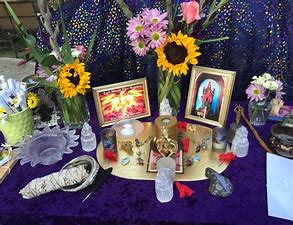
Altars come in all shapes and sizes, and people come as they are.

Don’t read the instructions

Whenever I buy a new device, like an external storage device for my laptop, or a vacuum cleaner, I generally decline reading the “destructions”. I find they make no sense whatsoever until I’ve been able to put my hands on the device and figure it out (to a degree) myself. it doesn’t make sense to me to simply connect parts when I can’t yet see how they fit together. I’m a Capricorn – I need to know what the destination looks like before I even start the journey, so I can focus on something while I’m traveling. I don’t know if that’s a good thing or not, but it’s how I roll.

Every once in a while I screw up mightily, like the time I somehow locked the extension wands for a new vacuum cleaner inside the body of the case, and could not retrieve them. Or that other time when I made changes to the registry on a new laptop and had to reimage the whole machine. (I assumed I already knew what I was doing, because I had owned several laptops already, so how hard could it be?) And the new vacuum cleaner I just bought, that somehow has an extra piece after assembly. I don’t even want to know what that’s for, but the dang thing works. I’m using the machine successfully…although intermittently, because now that I have it, I’ve suddenly found a dearth of motivation to actually vacuum. But, I digress.

I am still just reeling over the death of Ma’Khia Bryant in Columbus OH. This was a 16-year old Black girl, in a rage while fighting with some other girls in her driveway. The other girls had apparently come to call for purposes of fighting with her, probably over some typically ridiculous teen-age crisis, like a boy or some jewelry or something. She went outside and engaged. Not a good idea, but at 16, I didn’t have particularly good ideas most of the time. At some point in the confrontation, she armed herself with a knife. Also not a good idea, but one that is modeled on the daily by people 3 times her age.

The fight escalated, and she – not a neighbor, not an adult, not a bystander – called 911, asking for help to quell her attackers. By the time police arrived, things had escalated. She had the knife. She was a big girl, and she had dispensed with one aggressor, pushing her to the ground. She had another one in a clench, and was shoving her into the side of a car parked in the driveway. This is about when the body-cam video picks up. The responding officer was – I think, it was chaotic, with female voices screaming – told her to drop the knife. She did not comply. She was intently overpowering the other girl. The knife is out to her right side, and her arm draws back, when suddenly four gunshots ring out.

Four gunshots. Not one. Not two, Not three. But four. It takes only a few seconds, and a 16-year old’s life is over. She died on the scene, slumped against the car in the driveway. The officer still held his gun pointed toward her, even once he approached the body. I’m not sure if he thought there was a chance she might get up, or what, but it was clear she was not moving and was not going to be a further threat to anything or anyone. She. Was. Done.

The tragedy of this girl, Ma’Khia Bryant, is with me. It penetrates me. I expressed this to a few people last night on a Zoom call, and said that I couldn’t understand why the officer couldn’t have come up with a different solution that killing her. And he intended to kill her, because he shot her four times. He did not want, or intend, for her to get up. He said that he was protecting the other girl, but he shot in the same direction as that potential victim. He could have hit her as well, but no … he’s a marksman, it was reported. So, he knew what he was doing and did it well.

One of the participants on the call last night said that he’s had “criminal justice” training, and the officer’s actions were absolutely correct. If she had been able to stab the other girl, while he was trying something else, they might have been sued by the other victim’s family. (Huh?) I asked why he didn’t attempt to de-escalate. No time! I then asked why he didn’t have a taser or some non-lethal weapon, no response on that. I asked why he couldn’t have rushed the girl with the knife, knocked it from her hand, tackled her to at least break her focus. No, not enough time. By the time he would have made contact, she could have stabbed the other girl and his training says that he has to protect the other girl’s life. So, he had no choice.

OK, I let this go, because the purpose of this Zoom call was something other than discussing this event, but I very much wanted to come through the computer screen to slap the man uttering this opinion. But it made me very, very sad as well…he is a Black man, and upholding this status quo rhetoric made me way more than a little bit nuts.

I am still enraged over this girl’s death, and you’re going to tell me the officer had no choice but to shoot her because…if he didn’t the other girl’s family could sue if there had actually been contact with the knife? This is the decision point that you consider when you are on the verge of taking a human life? The possibility of a fucking law suit? Um, no.

My colleague on the conference last night also defended the officer’s actions, saying that he assessed the threat, and did the best thing for all involved. Really. It wasn’t the best thing for the girl who wound up dead. It wasn’t the best thing for everybody that witnessed that. It wasn’t the BEST thing for anybody, even him. He’s going to have to live with that.

This officer read the instructions: when perpetrator has weapon and threatens another citizen, shoot to kill in order to neutralize or eliminate the threat of the weapon. One size fits all – weapon present, they won’t comply, shoot. So that is what he did. There was no room for thought, no training involving alternatives or de-escalation or non-lethal weaponry. Just. Shoot. That’s what the instructions say, and that’s what he did.

My point is…this outcome was made possible by the same folks who brought you throwing people to the ground brutally because they talk back to you, shooting people multiple times because they make you chase them, running people over with your car because you can’t catch them when they run, and shooting people inside their cars because they have a gun they are legally authorized to carry. See a weapon, fire your weapon. Get them before they get you. And here’s the premise of all of it – your life is worth more than theirs. Every time. No questions asked.

When we are talking about Black Lives Matter, the emphasis of that is…sometimes they don’t. I cannot help but wonder, and yes believe, that if the officer in Columbus OH had responded to a scene with a group of white girls fighting in their driveway, even if one of them had a knife, this would have been handled differently. We have all seen perpetrators taken into custody alive following their shooting multiple victims, stabbing domestic partners or neighbors, armed with assault rifles, machetes, bigger knives than what this girl had. Taken alive.

There were alternatives in this situation, but the responding officer did have the motivation, for whatever reason, to explore those. If somewhere in his implicit bias he had determined this girl’s life was not really worth risking his own, that was the decision point. Was he conscious of that? Absolutely not. But that is where it starts, way deep down, in the perceptions we have that assign value and “rightness”. That is the pinpoint of where that girl’s death became inevitable.

I don’t know how we can change any of that. Implicit bias is a real thing, no matter how much we deny it, since it’s so sub-conscious and happens before we have cognizance to attach to it. But it rules us. It is the result of centuries of being told thing, of having our perceptions shaped by things that may or may not be true. And we have to root that out. It’s messy and uncomfortable, but we have to root that out, or humanity is going to die. Not today, or tomorrow, but what makes us human will not exist at some point. The thing we are so proud of, our ability to reason and make complex judgements and improve, that stuff that separates us from other life forms…that stuff will fade away. The species may survive, but we will not be humans. We will be something else, and I don’t know if that will be a better thing.

Where I get into trouble with some of this is making the judgement that implicit bias is based on fear. Ma’Khia Byrd was a big girl. She was a big, Black girl. The officer, as detached as he appeared, was making all sorts of judgements based on his implicit bias, and he could not relate to a big, Black girl who was so enraged that she wanted to stab another girl. And…she was ignoring him, didn’t respond to his orders to drop the knife. She was non-compliant. So, back to the instructions…if they are not compliant, and you can’t see any way to make them compliant, take charge of the situation and shoot them.

A 16-year old girl – or boy, for that matter – who is at that level of rage, that level of emotional distress, cannot hear “Drop the knife.”. She probably didn’t even register that police were on the scene, and the officer was behind her. I contend that had it been a white girl, who would seem more familiar to him, he would have felt more connected and related and would have done something different. A knife is not a distance weapon, so he knew that HIS life was not in danger (which is the battle cry of officers who shoot in other cases). But somewhere in his mind, he’d started from the implausible point of knowing that he couldn’t reason with her, because she was alien to him. I can’t say for sure that she was sub-human to him, but she may as well have been from another planet, because he did not feel a human connection with her. I contend that he very well might have, and probably would have, if she had been white.

I could have been Ma’Khia Byrd, as could any number of my friends. I have been that enraged, not able to see or hear anything, all of my senses shut down except for that laser-beam focus on the object of my rage. Police officers cannot be expected to be social workers, or psychologists, but they should also not be allowed to use deadly force in a one-size-fits all methodology. They knew it was a girl-fight as soon as they arrived. Ma’Khia’s 911 call had implied that as well. Why would you even get out of your patrol car with a gun drawn, rather than a non-lethal weapon? But again, the instructions say…if they have a weapon, shoot them if they don’t comply.

This is the policing system today. It’s not just Ohio, or Georgia, or Wisconsin, or Colorado. It’s everywhere. It’s the nature of the beast, because we are generally more concerned with protecting property rather than protecting lives. Whole lives, not just bodies, but whole lives. If someone is at that level of rage that they can’t see or hear a police officer’s orders, they need some kind of help with that. A bullet is not going to help that, especially if they’re dead. But quite literally, that was not his job. That is not what his instructions say.

So whose job is it? Well, basically , we don’t really care. The issues that produce that kind of rage, and the cultural idiom that says if you have a dispute with another teenager (or sometimes an adult), you posse up with your BFFs and pay them a visit so you can beat them up is a little problematic. But that starts way back in a culture, way back in time, and you can’t hope to resolve that on the spot with a gun.

Recreating the educational structure is where some of this needs to start. In pre-K, in elementary school, show these kids something different about how to resolve conflict. Programs that interrupt the class-to-class-to-class routine with things like yoga, and meditation, sound almost silly, but there is data to show improvement when those programs are implemented. Restorative justice methods are also showing transformation in some of most violent of schools. It will not be instantaneous, and may take a couple of generations to see obvious results, but if it’s continued I believe it would be worth it.

Implicit bias training, or not really training but reorientation, is also essential for adults. For adults of all races, ethnicities, abilities. We have to start getting to that pinpoint of decision, where our actions begin, where outcomes are really defined…before we even know it. Nailing down our nearly instantaneous judgements, that someone is “other” and not like you, and therefore not as good as you…that’s where it starts. If we can just get a split second between the stimulus and the response…a paper-thin interval…we might have a chance at becoming more aware of what we’re doing.

That paper-thin interval is how it works for me. Me, who has been a short-fused explosive device of mass destruction since I was a teen. There was NO space between stimulus and response. I was all reaction, all the time. I’ve got a bit of an interval these days, however, with a few exceptions, though…when my heart is involved, when I have been betrayed, when the hurt is blinding…I am entirely reactive. I will say, however, that I manage to avoid those situations more than I used to, so that’s another aspect of the transformation. But that’s another story…but I will say that my therapist has job security, for as long as she wants it. But, as usual, I digress.

So, I am not feeling hopeless about these kinds of situations, where young Black people lose their lives for being…young Black people. I am not feeling hopeless because I truly believe there are ways out of this trend, ways to rewrite the instructions, ways to keep another family from having to bury their child. But I am so very, very sad about it, because it’s going to take some doing, and I don’t know if our collective machinery is up to the task. It’s going to take some money, and a lot of effort, and a lot more willingness to change all this. We’re going to have to be incredibly uncomfortable, and incredibly persistent. We can’t give up and proclaim our efforts a failure after one or 5 or even 10 years of trying. We have to agree this is the best shot we’ve got, and stick with it, like you stick with raising a child even after the first time they break something you love and tell you they hate you. If you love them, you stick with it.

And there’s the rub. If you love them, you stick with it. Does the country love Black people enough to stick with us? We’re kind of not feeling that right now. We’re kind of feeling like the rules are different for us, and they’re somebody else’s rules anyway. We’re kind of feeling invisible until you need to shoot us, or shoot our kids, or our friends and wives and husbands and mothers and fathers. We’re having a hard time figuring out why you can’t understand how badly you’re hurt us, and how badly we grieve all the sweet talk you gave everyone so long ago that said things like life, liberty, pursuit of happiness. We are not feeling that – not feeling free, not feeling particularly happy, and you’ve been taking our lives for a while now. So what gives?

OK, maybe the big bright one, lower right, would be far enough away?

Nothing to see here

I started this on FaceBook this morning, but it needs to go outside and play.

I am beyond angry. I am beyond rage. Killing a 16-year old girl because she was in a rage, fighting with other teen-agers, like teen-agers have always done. Having the Speaker of the House say that George Floyd “sacrificed” his life. He didn’t sacrifice sh*t – he was murdered. His life was taken from him, without his consent.

Going through life numb is not the answer, and that’s why people of color have conditions like high blood pressure and diabetes in record numbers, the result of stuffing all of this and telling your body it’s not seeing what it’s seeing, It’s not experiencing what it’s experiencing, and that life has only bitterness to offer you.

This is mass murder in slow motion, this is genocide on a slow scale, but the results are still the same – dead Black bodies in driveways, on streets, in their bedrooms. I don’t have an answer that doesn’t depend on massive psychic change in the dominant culture, which means…I don’t have an answer. Dammit.

There are only so many times in a given day when one can have a cognitive disconnect and refrain from a reaction. Only so many times you can throw your hands up and say “fuck it”. Only so many times you can think “it’s gonna get better, there’s hope” and have that hint of an upturned lip be smacked from your face so hard you can hear it.

WTF, America? People have been saying this for centuries, and still, you want to defend lower life expectancy in PoC communities as their own fault, the result of poor lifestyle choices and refusal to listen to medical advice. Once again, compliance is all we need to do – if we would just follow the rules, everything would be fine. If we could just conform, we’d have fewer problems…with you. We’d have fewer problems with dominant culture, not with each other, not with our bodies, not with our socio-economic status, but with people who occupy the dominant culture, the higher steps on the caste.

If I suddenly realize the error of my ways and start eating like a teen-aged white girl, I would lose all of the excess weight that charts say is shortening my life span. So, if I did that and was 100 pounds lighter by tomorrow, will that get me all of the societal acceptance and a fair shake at everything I might want? I think not. Will that mitigate the grief I feel everytime I read or watch the news of yet another unarmed Black person being shot by the police? As though no other solution could possibly exist for a 16-year old girl acting out in a rage but to put her down like a dog who has bitten someone? Just put ’em down, they can’t be fixed, so…just put ’em down. They won’t feel a thing.

That’s the problem, though. They won’t feel a thing because they already CAN’T feel a thing. Numbness is maddening. It’s an itch you can’t scratch. I have said that so many times I’m tired of hearing myself say it. When you are numb, you still feel the pain, it’s just not the sharp, pointy thing you’re accustomed to when all of your nerves are alive. It’s a dull, muted ache that nags at you, insistently, unceasingly, like background noise that irritates but becomes so integrated into the fabric of your being you can’t differentiate between that and a scream. So you scream, scream at everything you encounter, scream at everything you want to encounter but can’t. Only when that dull, fuzzy ache stops can you discern that it’s been the source of your irritability all along.

What kind of life is this to offer to a kid? What kind of life is this to offer to ourselves? I could have been Ma’Khia Bryant. With all the crap I pulled back in the day, I have been convinced I have survivor’s guilt. People I know did much of the same lunatic stuff I did but they had consequences I somehow managed to escape. But when I saw that girl in the body-cam video, knife and everything, I saw myself. I saw the rage and despair that is the life of a 16-year old Black girl. The police officer could have screamed at her to drop the knife until the cows come home, but it wouldn’t have mattered – she couldn’t hear him. Rage drowns out everything.

So, when I hear “angry Black woman” tossed around as a pejorative, I want to stand up and scream “THIS is an angry Black woman!” and let it rip. Is nobody else supposed to express anger but petite white women, or virile white men, who do it “appropriately”? Give me a break. There’s no such thing as “appropriate” when you’re having emotional response, and sometimes the appropriate emotion is anger. Why is it not OK for people of color to express that?

Oh, I forgot – there are rules, and decorum, and professionalism…and keeping your cool. Don’t let them see you sweat. If you show emotion, they’ll know they’ve got you – don’t give them that power.

Well, you know what? I am giving them power by considering them in my emotional response in the first place. By considering whether or not it will be received well, in the spirit intended, whether my emotions will offend, or frighten, or be entirely misunderstood. Will I be heard, or judged for being overly sentimental, for making excuses for bad behavior? Will I be seen as having a right to whatever feelings I am having?

I am angry, and just because I don’t choose, or feel compelled, to pick up a knife or a gun doesn’t mean that I am any less angry than those who do. I am angry because those who do harm to other people are always the ones who get the attention, one way or another. I am angry because collectively, we have all brought this into fruition – those of us who believe ourselves to be superior to the rest of us, and those of us who believe ourselves to be inferior to the rest of us. Neither extreme is helpful, productive, or real. Neither is relevant in trying to survive.

A virus, a volcano, an earthquake, global warming…none of these know skin color, or culture, or intention. I am tired of hearing the whining about being intentional about stopping climate change. You can’t stop it. We’re not that powerful. Perhaps we’re better off trying to figure out ways to cope with it, compensate for it, and not make it any worse. But let’s not delude ourselves – we can’t stop it.

We can, however, stop generating the kinds of esoteric heat that I believe fuel the climate change and will knock this planet right off its axis eventually. The hatred and the greed and the dependence on knowledge. Facts are useful, but they do not make us wise. Wisdom is what is needed to design solutions and feel – literally feel – our way through all of this. If we cannot feel, we may as well be talking heads that should be kept in a jar.

I’m so tired of trying to make my emotions right for everybody else. Right now, I just don’t have the energy. I’m tired of being slightly afraid to wake up in the morning because I want to shield myself from the inevitable onslaught of tragic news, with accompanying video. Tragic news has come before, but not this steady flow of devastating inhumanity.

And so. What can we do? Short of everyone being issued a firearm, lining up, and shooting the person next to you until we’re all dead…I don’t know. Is this simply a part of human nature, where everyone has become so desensitized and we are so assured of species efficacy that collateral damage is acceptable? Is this how our species will end, with humanity being a lost attribute entirely? We may remain homo sapiens, but the emotional characteristics that set us apart from other life forms has retreated. Perhaps this is what the trend toward artificial intelligence will eventually lead us to?

If humanity is worth fighting for, I suppose we’ll have to do it. That started with our recent understanding that truth is not relative, and that some amongst us feel that it is. Truth is reality…not what you feel about reality, but what is actually there. I don’t know if what I call the color blue is the exact same thing you see, but we can both agree there’s an object with a color that we each label as blue. Some of us don’t believe there’s anything there to begin with. That’s a problem.

For me, truth begins somewhere inside me, and I usually call it honesty. I know damned good and well when I am bullshitting myself, and so do most people. As a kid, I could lie with impunity, but I knew the difference between a lie and the truth. Did you steal that candy bar? No, I absolutely did NOT! But of course I knew that I had stolen it, and how dare you even think I did. I might have won that battle, but I had lost the war, because I always had a conscience. Dammit. Wrestling with my conscience over the years is what helped cement my impression of myself as a loser, and a worthless person. That long ago battle over a candy bar was forgotten, but the war had raged on.

I continue to believe that all of this police drama is just a crack in the mountain side, where the lava leaks out. The mountain is a portal to the core, where molten rock is straining upward and ready to blow sky high. For us, right now, it’s a societal core, and it is racism. That rock, that status quo, has been heating up for centuries and has become molten, and it’s starting to leak out. Slavery was a fault line, where rocky plates shift. The Civil War was another fault, and there have been after shocks for another couple of centuries – the Civil Rights Era being one of the most recent. And now, we’re here, in this new millennium, hurtling toward destinations unknown, and we’re scared. We should be scared.

Can we stop this eruption? Maybe. Maybe it’s exactly what needs to happen, that forces we’ve unwittingly marshalled destroy everything we’ve know, everything we’ve built, and we are forced to begin again. Not rebuild. Not repair. Start over. I don’t want to see us fixing broken things, or getting back to “normal”. This was never “normal”. There’s no such thing as “normal”. There is routine, there is ordinary, there is expected. But “normal” is what we have taken to naming the comfortable. When we’re comfortable, we have no need of innovation, or creativity, or anything new. We just…go to sleep in the sun.

Until the sun becomes too hot, and we find it uncomfortable, then we need to do something different. Find shade. Build awnings and roofs. Invent power distribution methods. Invent fans, then refrigeration and air-conditioning. We’ve got to figure out how to air-condition this raging fire of bias and literal distemper, the ever simmering quest for power. We’re getting the sinking feeling that we’ve built on a flood plain, or a swamp, and the ground is shaky. We’re being thrown out of Eden yet again, because…that’s just how it goes. Nothing is truly permanent.

Once I learned that everything is impermanent, it occurred to me that i have no entitlement to any of it. I am annoyingly human, though, so letting go of things I have come to enjoy and love is difficult. What I also know, though, is that when I fight hard to maintain my comfort level, there’s a fear underneath that. When I am fighting to keep a job that i don’t even like, where I am treated badly, what am I afraid of? In my case, it was afraid to lose the comfort of a pay check, benefits, a fragment of status that I was gainfully employed and had some “security”. Underneath that fear, however, was the whole issue of self-confidence, self-worth, self-esteem. I didn’t need to work on changing that heartless company, which I was never going to accomplish, I needed to work on changing my beliefs about myself.

And so here I am, trying to believe that i have something to offer no matter what those morons believe. I was saying earlier today that while I’m still not particularly enamored of how the whole layoff thing went down, I do not miss that job in the least. I’m no longer wrapped up in how much I hate them, about how it wasn’t fair, about how I was mistreated. I don’t like them, and would not go back to work for them. Ever. But I have gained a great deal in figuring out what I am supposed to be doing in this world, and who I really am. Those are questions that have plagued me for so long, and now there is a fair measure of peace in having some direction on those fronts.

Because I am having that experience now, I can see how people can become so bitter when things aren’t quite working out as they expected. If I don’t deal with the fear, I will never get to where I’m supposed to be. Where I’m supposed to be will never depend on anybody else doing something for me, or against me. Nobody is that important in my life, unless I allow them to be. I was told this over and over during my life, but until you are ready to understand that, on some deep and nonintellectual level, it will make no sense. Hopefully, that will come sooner rather than later, but some of us (like me) are late bloomers.

Blooming is a real deal, I suppose, although I really don’t want to descend into the mire of Hallmark cards or something. But, revisiting that whole inherent worth and dignity piece once more, I suppose everyone has something to contribute to the world. Some contributions seem counter-productive, even destructive. I would say that even those are necessary, albeit uncomfortable and often inducing great suffering. But, where there is darkness…light, where there is conflict…peace, blah blah blah. I will leave it at where there is yin, there is yang. Opposites attract. There is matter and anti-matter, Captain, and ye’d do well to keep them separated.

So, for today, I will rest uneasily in the knowing that a 16-year old girl in Ohio, and a 20-something year old guy in Brooklyn Center MN, and a 40-something year old man in Minneapolis, and a bunch of other people, too many to name, have contributed to reality as it exists right this second. I hate that it took that for me to be sitting here, in this mindset at this moment, because how those people moved through – and out of – this world was painful. Painful for them, and for those they touched, and for all of us who witnessed them. I am told suffering is inevitable by many Buddhists. I am told pain is inevitable, but suffering is optional by many recovery folks. I don’t know which is which, but I suppose what I do know is that I am not entitled to joy all the time, and nothing lasts forever in its current form. Dammit.

Pay no attention to the man behind the curtain. You’ve always know how to get home.

Not again!

Definition of justice

1 a: the maintenance or administration of what is just especially by the impartial
adjustment of conflicting claims or the assignment of merited rewards or punishments
// meting out justice
// social justice
b: JUDGE
especiallya judge of an appellate court or court of last resort (as a supreme court)
// a supreme court justice
—used as a title
// Justice Marshall
c: the administration of law
// a fugitive from justice
especiallythe establishment or determination of rights according to the rules of law
or equity
// a system of justice

2 a: the quality of being just, impartial, or fair
// questioned the justice of their decision
b (1): the principle or ideal of just dealing or right action
(2): conformity to this principle or ideal RIGHTEOUSNESS
// the justice of their cause
c: the quality of conforming to law

3: conformity to truth, fact, or reason CORRECTNESS
// admitted that there was much justice in these observations

Merriam-Webster’s definitions of justice. Seven alphabetic characters, with enormous meaning. Seven letters that carry tremendous weight. Seven marks that often represent something elusive, and often associated more by their antithesis injustice.

Justice and fairness are not equivalent. We often make the error of believing that if everyone is given the same outlay, there is justice. The classic example is a visual depiction of three baseball fans viewing a game from behind a wooden fence. None of them can see over the fence, so all three are given a box to stand on, boxes of equal height. All three step onto the boxes, but only one fan can now see over the top of the fence – the fans are all different heights, so only the tallest one is helped by the box. The other two are still not tall enough to see over the fence. The equitable solution is to give all three boxes to compensate for their disadvantage, but the boxes are of variable height. The tales fan gets a box of minimal height, the shortest gets a box of greater height. Each box is tailored to meet the goals of the distribution, so they are not the same boxes but fairness is measured by the achievement of the goal, which is to see over the top of the fence.

Justice is complicated. The concept is simple, but implementing just solutions are complicated, expensive, difficult. Justice takes a long time, in many cases. One of the other problems with implementation of just solutions is this – who gets to make the decision about the size of the box in the baseball fan example? Who gets to evaluate whether or not the goal has been achieved, who gets to decide where the boxes are placed? Who gets to decide if boxes will be used, or the fence lowered, or possibly that fans be required to view the game from inside the fenced area.

This is where things get a little complicated, partially because we can’t trust each other. We have to legislate the ultimate goal – should all fans be allowed to see over the fence that started the discussion? Should they have to pay more to watch the game from the other side of the fence? Are boxes the best method of achieving the goal? Where should the boxes come from, made out of which materials? Should the fence be lowered, and if so, by what order of magnitude? Will anyone benefit unfairly?

Answering those questions is the job of legislators, policy makers, governmental entities. Questions like these are the stuff of Congressional hearings, City Council meetings, Board of Alderman, etc. People elected or appointed by another cache of elected or appointed decision makers. Every once in awhile, there is public input.

In a perfect world, we’d start with public input, and community discussion. We’d start with data, and facts to illuminate a problem, and we’d move on to community work. Very often, it seems the process goes from data to legislation, bypassing the community input. We are eager to get to solution, to have “something to show” for the effort of tackling the problem, that we vault over important hard and soft data that could enable a truly equitable, and more effective, solution.

While everyone was digesting the outcome of Derek Chauvin’s trial yesterday, as I keep saying, life was still going on. An Ohio police officer shot a 16-year old African-American girl to death last night. It seems the victim had actually initiated the call for police to come to the scene of her altercation with other girls. They were fighting in the driveway of a residence, an ordinary scene, cars in the drive way, neatly trimmed lawns lining the scene. The officer’s body-cam video shows a typical teen-ager fight scene, chaotic, two girls in a clench and shoving each other into the side of one of the cars. Suddenly, in the clench, one girl is seen to have a knife in her right hand, and she has the other girl in her grasp. It could be construed that she is beginning the motion to stab the other girl, at which point the officer fires. He fires four shots, killing the knife-weilding participant, who is determined to be the one who called for police assistance.

This is a new one. The scenario of most of these news-worthy killings of unarmed Black men has been “the officer was in fear for his/her life”. They had no choice but to shoot. The situation in Ohio was a little different. This was an every-day girl-fight. It happens literally every day, more often with boys and young men, but girls are not exempt from this behavior. So, the officer was not “in fear for his life” when he fired. He said that he was protecting the life of the other girl, who could have been a victim of the knife. He shot her four times. Hm.

Let’s say his rationale was correct, and the victim was going to stab another girl. If she had been successful, she may very well have inflicted grave injury to the other participant. Maybe. The officer had shouted instructions to drop the knife, but in the heat of the battle, his order was ignored. The victim was non-compliant, so once again…a non-compliant Black person is dead. The officer was not in danger. If he was legitimately convinced that he had to shoot her, in order to stop her aggression toward another person, he could have shot her once. Did he have a tazer? Was he alone, or was there backup? I repeat – he shot her FOUR times. Law enforcement is no longer trained to shoot to wound – they shoot to kill. So, he intended to kill her. A 16-year old girl, fighting with another girl. He intended to kill her. I have a problem with that.

Yes, I understand this was a split-second decision. Yes, I understand it was a chaotic scene. But once again, I return to the training objectives and the zero-tolerance culture of compliance that governs law enforcement now. She did not respond to him or follow his orders, so she was a non-compliant enemy combatant, and he did was he was trained to do – he eliminated the aggressor. She was of no threat to him. His life was not in danger, but I contend that what sealed her fate was her non-compliance. Had she turned to face him while still holding the knife, he probably would have shot her anyway, because that would be interpreted as aggression. This is how officers’ training has been described – zero tolerance. They comply or you get control of the situation, however you need to.

That’s just dandy, except there are documented cases of tolerance offered to certain perpetrators. Kyle Rittenhouse was given a bottle of water, while continuing to should his assault weapon after having shot two protestors during a protest. He was a 17-year old white male. The Boulder shooter was firing directly at officers, and he was taken into custody alive, with a leg wound. Other mass shooters in custody, who are white, have been taken into custody alive and well, despite having distance weapons and directly aggressing on officers. Why couldn’t a 16-year old girl with a knife – not a distance weapon – have been taken into custody short of taking four shots from an officer’s gun?

The people who witnessed that girl’s shooting are bound to that event for the rest of their lives. They will see it in their sleep, on the toilet, while driving to the grocery store. Another family is shattered, and will end their lives without this child. Another mother will bury a child. The solution of conflict management in this fashion is overkill. It satisfies the goal of crime reduction and maybe the protection of human life. Maybe. The solution, though, misses a huge part of the problem – you can’t just shoot ANY person with a knife aggressing on another person. Both parties in this situation were participants in the physical conflict. This was not a case of an attack on an “innocent” person who had no involvement. These girls were known to each other. It was a fight. The girl who is now dead had called the police because she felt that HER life was in danger. She received the stock answer to what happens when a generic person is wielding a knife and does not comply with officer commands. She. Died. I guarantee, she never knew what hit her.

You can’t just use a one-size-fits-all approach to law enforcement, or racial equity, or justice. There’s no reason a law enforcement officer, or some enforcement agent who carries a gun, can’t figure out that shooting a 16-year old girl, who is not a threat to the officer, is literally overkill. Again, where was his taser? Where was his backup? where was his de-escalation training? Where was his compassion and caring and desire to come up with a better solution than failure to comply = death?

I am still very gratified that Derek Chauvin was convicted of George Floyd’s murder yesterday. I hesitate to say that I’m happy, because I would not wish that resolution on anyone – one guy is going to jail, and his family will suffer for something over which they had no involvement or control. He will suffer, which I’m not totally concerned with, but don’t wish for anyone. George Floyd will not be returned to his family or this world. So, I don’t know if that’s justice, but possibly it’s a step in the direction of justice.

The fate of this 16-year old in Ohio is not a step in the same direction. Just as in the case of George Floyd, I don’t believe the officer went to the scene of that fight with the intention of killing anyone, or harming anyone. I do believe, however, that his training robbed him of the ability to think critically about what he was seeing. He saw a line from a training manual that said a person with a knife who doesn’t follow y our instruction to drop it should be shot if they look as though they’re trying to stab anyone. No shades of grey. No hesitation. Just shoot, and shoot to kill. And that was literally…the end. For a 16-year old, who may really have been guilty of having an anger management issue. Or she felt that her life was in danger, and she was defending herself. In either case…was that worth her life?

Maybe this is what he saw? It’s a little different than what was happening.

Hope, maybe

So. The trial is over, the verdict is in. George Floyd’s murderer has been found guilty of Murder 2, Murder 3, and Manslaughter. There will, of course, be appeals. But right now, Derek Chauvin is in jail, and bail has been revoked.

I had been hoping to hear the words “Remanded into custody”, and today, I heard that. He was led away in handcuffs, and there was some very small gratification in seeing that. It was very small, though, because I really don’t want to wish suffering on another human being.

While my attention has been so devoted to this trial and legal process, life has been going on in the background. My congregation has lost three members over the past couple of months, two in the last couple of days. I will never see them again, and I cannot remember the last time I did see them. We have been separated for so long, I can’t remember what it’s like to sit in the same room with people, eyeball them to observe their health, notice decline, if any. This does not feel good.

In my jumble of emotions about the Derek Chauvin verdict, I missed a meeting that I very much wanted to attend. I somehow didn’t register that today was Tuesday. It was the day of the verdict. But that was just my focus, not everyone else’s. There are families grieving the loss of a loved one, just like I had to do three years ago when my mother died. When I say that I am feeling that loss for someone else, I really do mean that…I just got interrupted today.

Tomorrow is a new day, and I hope it represents a chink in the armor of the status quo machinery. I don’t know if the fledgling hope that I have will thrive and flower into some lushly blooming living thing. I truly want this to be a turning point, but I have to be braced for the resistance. That’s self-protective, actually. I don’t want to flit off into Wonderland believing that everything is done. I know that’s not true. We have work to do. Lots of work.

I saw a segment on CNN this morning with George Floyd’s brother, and Emmett Till’s cousin. The Floyd family and Emmett Till’s family have joined together in solidarity, for justice, for honoring their loved ones who were so brutally murdered. Emmett Till’s murder was solved, but the murderers, three white men, were acquitted by an all-white jury. Justice has not been served. This interview was, of course, before the Derek Chauvin verdict was announced, but it was clear how much history was riding on that decision.

So, again, I am hoping that finding Derek Chauvin guilty of all three counts against him represents a turning point in this country, one that brings us to increased racial equity, a more equitable manifestation of justice, and even a new appreciation of our democracy. I need justice to come alive once more, with a blindfold. I need democracy to show her true colors. I need to believe in my country again. I hope that’s what started today.

Justice is blind, and she carries a well tempered sword.